How Do AI Model Access Controls Actually Work?
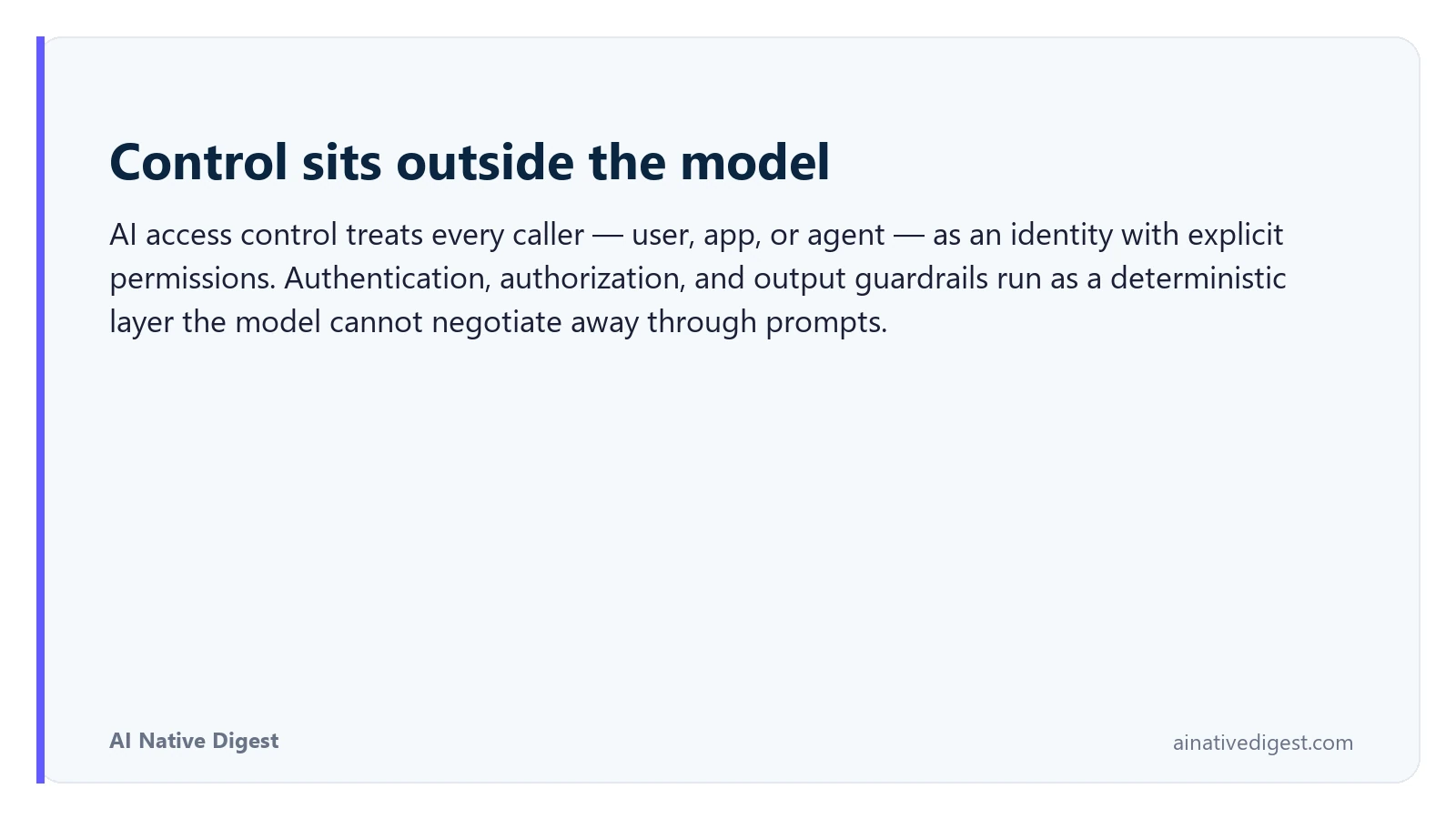
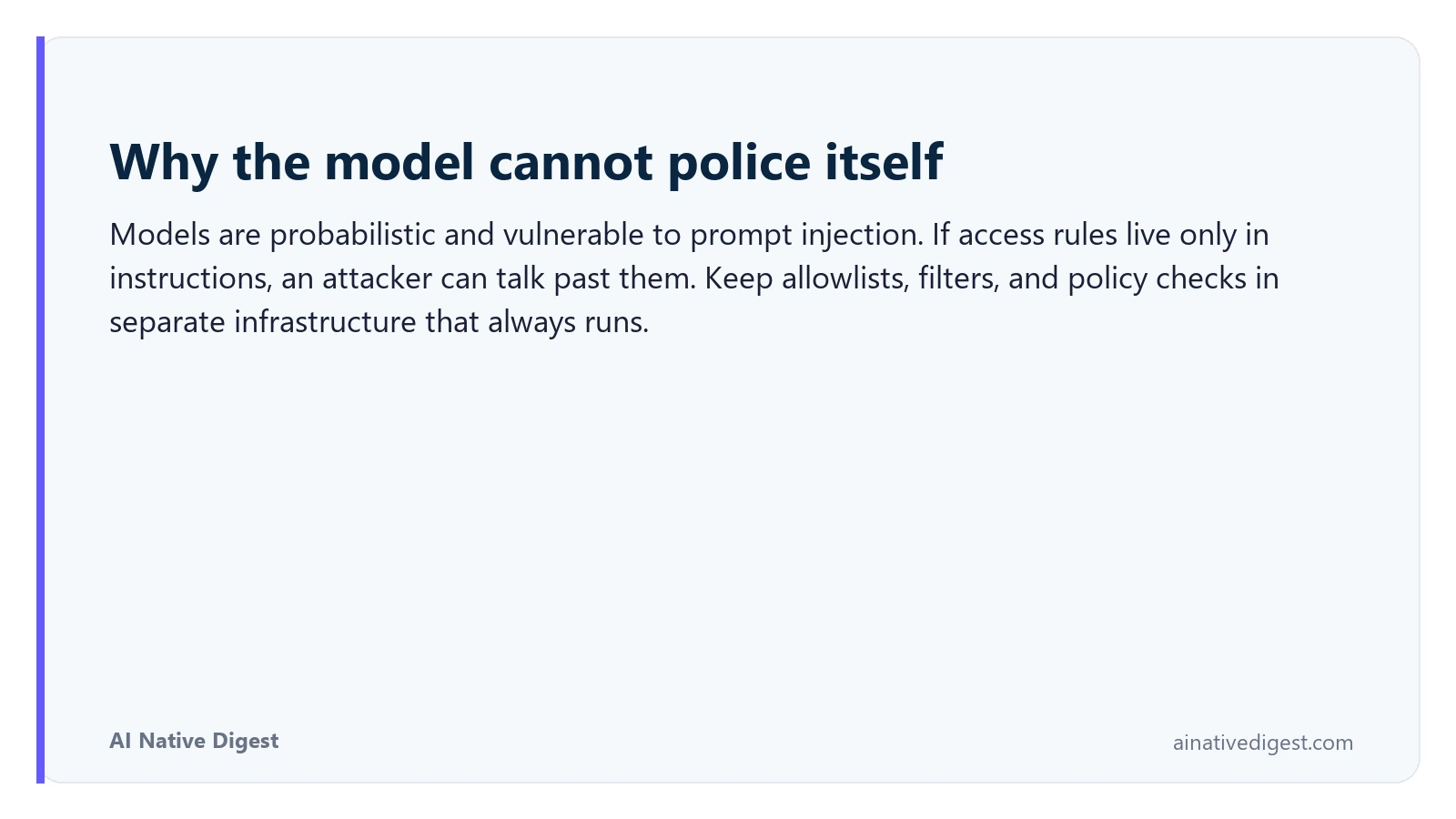
AI model access controls work by treating every entity that can call a model or touch the data behind it — whether that’s a human user, an application, or an autonomous AI agent — as an identity with its own permissions, then enforcing those permissions independently of the model itself at every step: authenticating who or what is making the request, authorizing exactly what it’s allowed to do based on role and context, and applying guardrails on both what reaches the model and what the model is allowed to send back. The reason this has to happen outside the model rather than inside it is simple: a model is probabilistic and can be manipulated, through prompt injection or unexpected input, so it can never be trusted to police its own behavior — access control has to be a separate, deterministic layer that the model cannot talk its way around.
Why AI Access Control Isn’t Just Ordinary Access Control
Access control as a concept isn’t new — the principle of least privilege, where a user or system gets only the exact permissions it needs and nothing more, has governed enterprise security for decades. What’s changed with AI systems is what needs to be governed. A traditional application has a fixed, predictable set of actions it can take. An AI agent, by contrast, can be given tools, can chain multiple actions together, can decide at runtime which systems to query or which data to retrieve, and can be steered by inputs — including a user’s own prompt, or content it reads from an external document — in ways its designers didn’t fully anticipate in advance.
This changes the access-control problem in a specific way: you’re no longer just controlling what a static piece of code is allowed to do, you’re controlling what a dynamic, language-driven process is allowed to do while it’s actively deciding what to do next. That’s why the first principle of AI access control is to stop treating an agent as a fuzzy extension of whichever human happens to be using it, and start treating it as a first-class identity in its own right — one with its own credentials, its own scoped permissions, and its own audit trail, separate from the human who triggered it.
Authentication and Authorization, Together
Two distinct questions sit underneath every access-control decision, and both have to be answered before a request goes through: authentication, which verifies who or what is making the request, and authorization, which determines what that verified identity is actually allowed to do. Neither one alone is sufficient — knowing who someone is doesn’t tell you what they should be allowed to touch, and having a permission model means nothing if you can’t reliably verify who’s asking to use it.
In practice, this is usually implemented with role-based access control, or RBAC, as the foundation: you define roles — an admin role, a read-only viewer role, a narrower custom role scoped to a specific application or team — each carrying a defined set of permissions over specific resources, and you assign those roles to whichever identity is making requests. Permissions are typically additive, meaning an identity’s effective access is the union of everything its assigned roles grant, which keeps the model simple to reason about even as the number of roles grows.
Why Roles Alone Aren’t Always Enough
Role-based access works well for coarse, relatively stable distinctions — this application can read the customer database, that application cannot. But AI systems often need finer-grained, context-dependent decisions that a fixed role can’t fully express on its own: should this specific agent be allowed to access this specific record, given the sensitivity of the data, the time of day, or the broader task it’s currently executing? That’s the gap that attribute-based access control, or ABAC, is designed to fill — layering contextual conditions on top of a role, so that a decision can depend on live attributes of the request rather than only on a static role assignment.
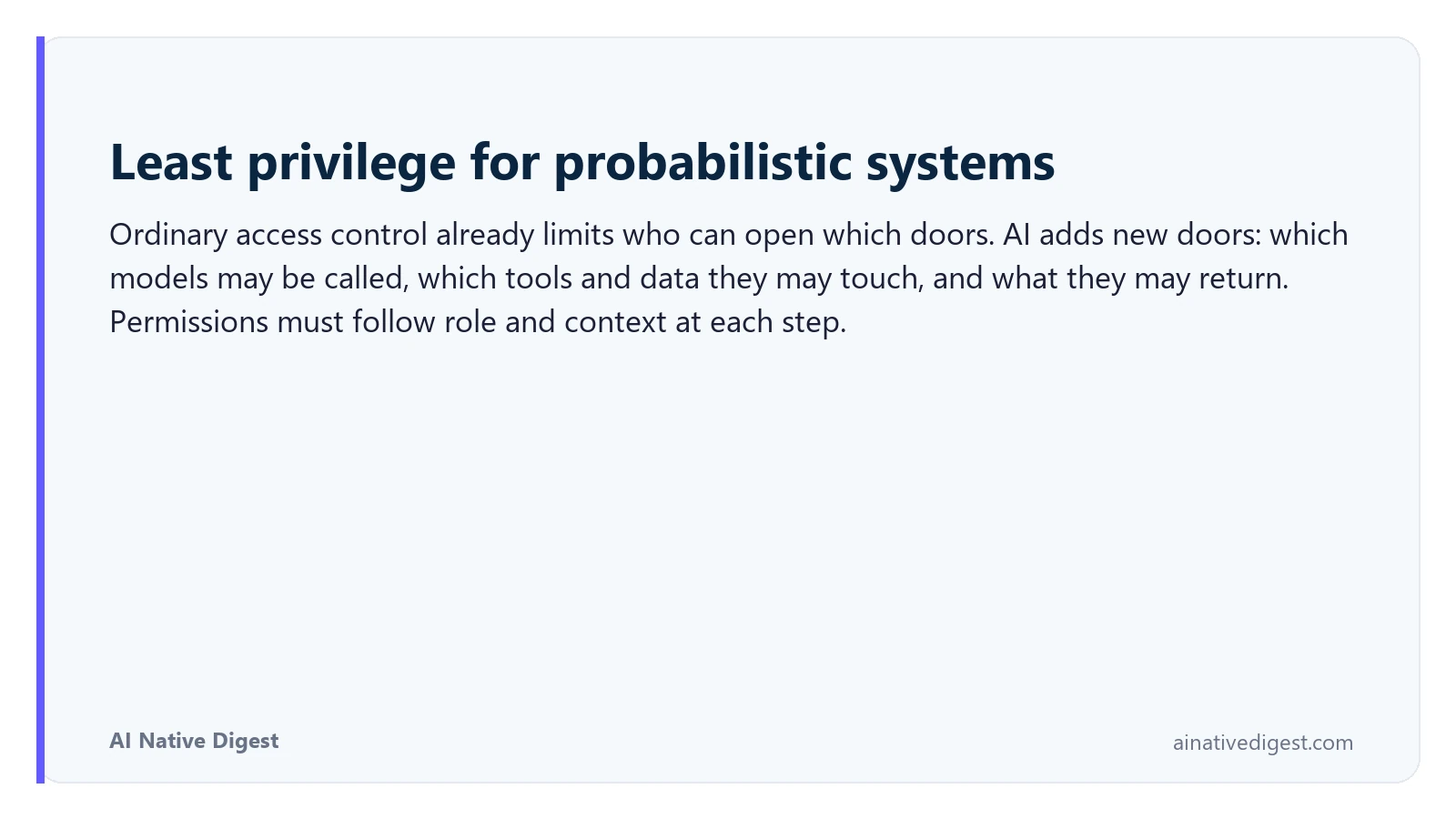
In practice, this usually means using role-based access as the base structure — because it’s simpler to audit and reason about — and layering contextual, attribute-based checks on top of it for the situations that genuinely need finer granularity. That hybrid approach avoids the two failure modes that show up when you commit fully to either extreme: a pure-RBAC system that’s too coarse to express legitimate nuance, or a pure-ABAC system so complex that nobody can confidently predict what a given request will actually be allowed to do.
This is also why access control for AI systems increasingly needs to be evaluated continuously at runtime rather than checked once at login. A traditional system authenticates a session and then treats permissions as fixed for its duration. An AI agent’s context — what data it has already touched, what task it’s mid-way through, how sensitive the next requested action is — can shift within a single session, so the access decision has to be capable of being re-evaluated in the moment, not just granted once and forgotten.
Guardrails Around the Model Itself
Beyond controlling who can call a model and what data they can retrieve, there’s a second layer of access control that applies to the model’s inputs and outputs directly. Controls applied before a prompt ever reaches the model — filtering out personally identifiable information, blocking disallowed content, screening for specific restricted keywords — limit what the model is exposed to in the first place. Controls applied after the model generates a response — redacting sensitive content that leaked through, checking outputs against factuality requirements, enforcing an expected structure or format — limit what the model’s response is allowed to do once it exists.
Together, these two guardrail layers form a boundary around model usage itself, distinct from but complementary to the identity-and-permission boundary around data and system access. A well-controlled AI system needs both: the wrong identity should never be able to reach the model or its underlying data in the first place, and even a legitimate request should still pass through input and output guardrails before anything sensitive changes hands.
Credentials Are Their Own Attack Surface
A significant share of real-world AI access-control failures don’t come from a flawed permission model at all — they come from an exposed credential. An API key committed into a public repository, hardcoded into client-side code, or left in a place broader than intended creates a direct path for unauthorized programmatic use of a model, with real consequences: unexpected billing from unauthorized usage, service disruption when a quota gets exhausted by traffic that was never legitimate, and in more serious cases, a foothold into whatever else that key was scoped to touch.
The mitigations here are concrete and mostly procedural rather than architectural: rotate credentials on a defined schedule rather than leaving them static indefinitely, automate that rotation so it doesn’t depend on someone remembering, keep secrets out of source control and client-side code entirely, monitor usage patterns so an anomalous spike gets noticed quickly, and set hard usage quotas at the provider or gateway level so a compromised key has a ceiling on the damage it can do before anyone reacts. As organizations scale up the number of models and applications in use, routing that traffic through a centralized gateway — rather than letting each team manage its own credentials independently — makes this kind of monitoring and rotation consistent instead of dependent on every individual team getting it right on their own.
Extending This to Training Data and Privileged Access
Access control for AI systems doesn’t stop at inference time. The data used to train or fine-tune a model deserves the same rigor as any other sensitive dataset — validated sources, encryption both at rest and in transit, and restricted access to whoever actually needs to touch it during the training pipeline — because a model can absorb and later reveal patterns from data it was trained on, which makes training-data access a genuine extension of the same access-control problem, not a separate concern.
The same logic extends to privileged access more broadly. Traditional privileged access management, the discipline of tightly controlling and auditing accounts with elevated system permissions, applies just as directly to AI agents that have been granted the ability to take real actions on real systems. An agent with write access to a production database or the ability to trigger external actions is, from a security standpoint, a privileged identity — and should be governed with the same discipline as a human administrator account: scoped permissions, session auditing, and the ability to revoke access immediately if something looks wrong.
Verifying the Controls Actually Work
None of this is worth much if it’s only designed on paper. Organizations that take AI access control seriously test it the way they’d test any other security boundary: deliberately attempting to exceed granted permissions, checking whether guardrails actually block what they’re supposed to block, and auditing logs to confirm that access decisions match what the policy intended rather than assuming the configuration is doing what it says. Because AI systems can be steered by inputs in ways traditional software can’t, this kind of active verification matters more here than it does for a conventional application with a fixed, predictable set of behaviors.
Bringing It Together
None of these pieces work in isolation. Treating agents as first-class identities only matters if authentication and authorization are actually enforced against those identities. RBAC and ABAC only produce sound decisions if credentials are managed well enough that the identity behind a request can be trusted in the first place. Guardrails on model inputs and outputs only matter if they sit outside the model rather than depending on the model to police itself. And none of it holds up over time without deliberately testing that the controls behave the way they were designed to. AI model access control, in the end, isn’t a single feature you turn on — it’s the discipline of applying identity, permission, and verification consistently across every layer where a model, an agent, or the data behind either of them could otherwise be reached by something that shouldn’t be able to.